Where do you stand on the AI adoption curve — and what does it take to move up? I sat down with Tempo's Rachel McConnell for a webinar on how AI-mature your content design practice is. Learn how to assess where you are today, and the steps you can take to level up.
How product gets shipped has changed
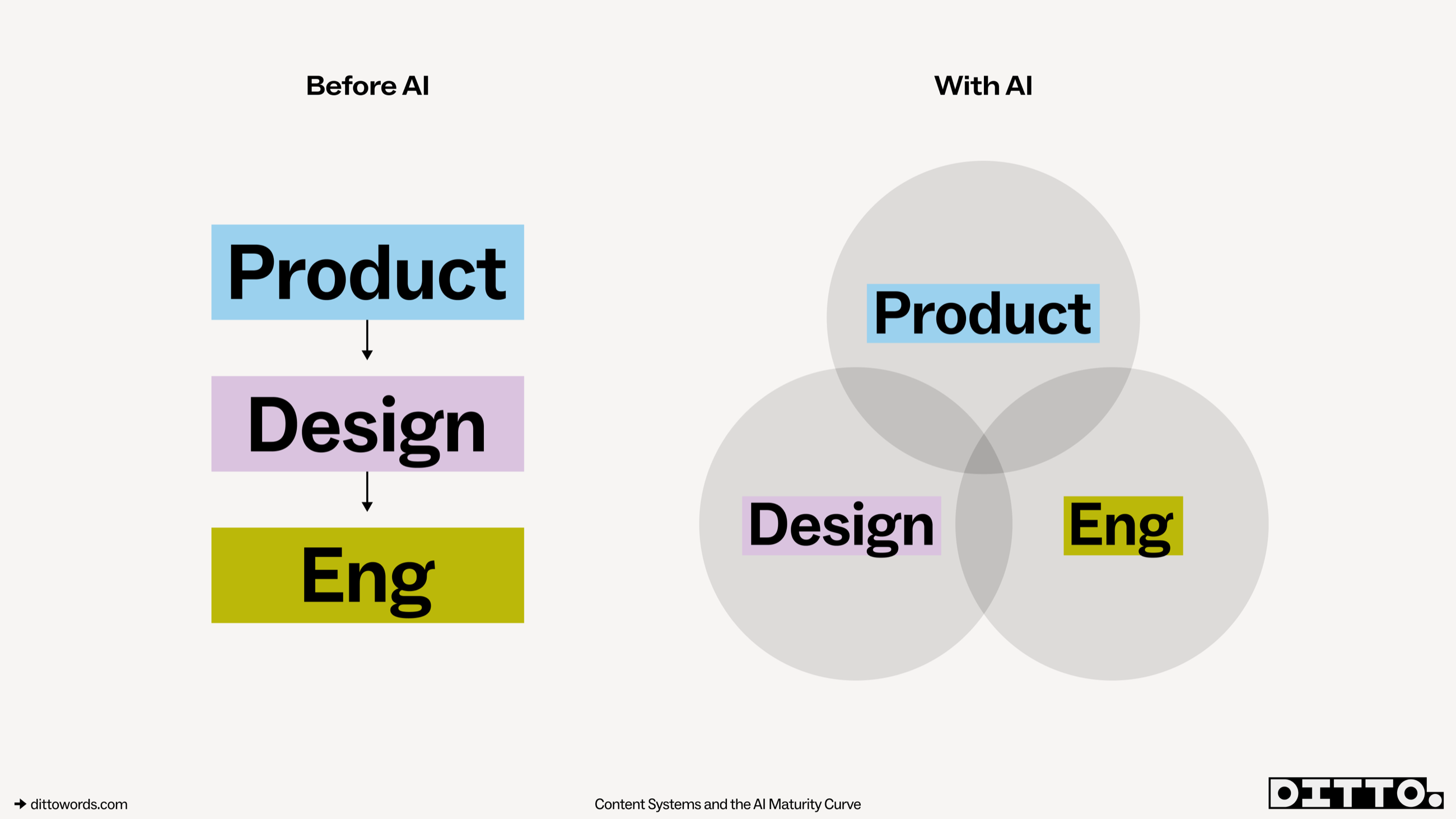
Before AI, shipping product text involved clear handoffs: product, then design, then engineering. With AI in the mix, that line has largely collapsed, with product, design, and engineering all working in the same space at once.
Even as workflows move closer to code, the job isn't to become a software engineer. It's to understand how your team is building now, and where the old limitations have shifted.
AI has led to real gains for product copy. It's also created problems that didn't exist before.
AI can generate product copy now, and a lot of it. That's already changing how teams work for the better. But it's also surfaced risks that weren't possible under traditional processes.
The good:
Fewer handoffs, fewer disconnected artifacts. Teams are working directly in the product itself instead of passing copy through a chain of documents.
Nobody's bottlenecked by technical roles anymore. Fixing a typo in development no longer requires waiting on an engineer. Whoever notices it can fix it.
Copy isn't the bottleneck for everyone else, either. With the right setup, anyone on the team can create a first draft — freeing dedicated writing expertise to focus on strategy and scaling the process itself.
The risks:
More automation, less governance. Manual handoffs used to force a review step by default; now a pull request can skip straight to production with none of those checks.
Back to single-player mode. As code becomes the source of truth, teams shift to tooling built for one person and an AI agent, not for the rest of the team to see or manage.
Proving it works is the hard part. Vibe-coding something together is easy. Proving it works, keeping it working at scale, and keeping it current isn't, especially since AI won't reliably reference the guardrails you've built.
Everything goes stale, fast. Product text and the .md files or skills built to support it go stale as fast as the product changes, and someone has to own that maintenance.
Text still matters to shipping great products (maybe more than ever)
These changes haven’t made writing less important. More product volume, more personalized flows, easier localization, custom education, hyper-personalization — all of it depends on text holding up at a scale no team has had to handle before.
AI creates more product language. A system keeps it correct. But not all systems are made equal.
Where are you on the AI maturity curve?
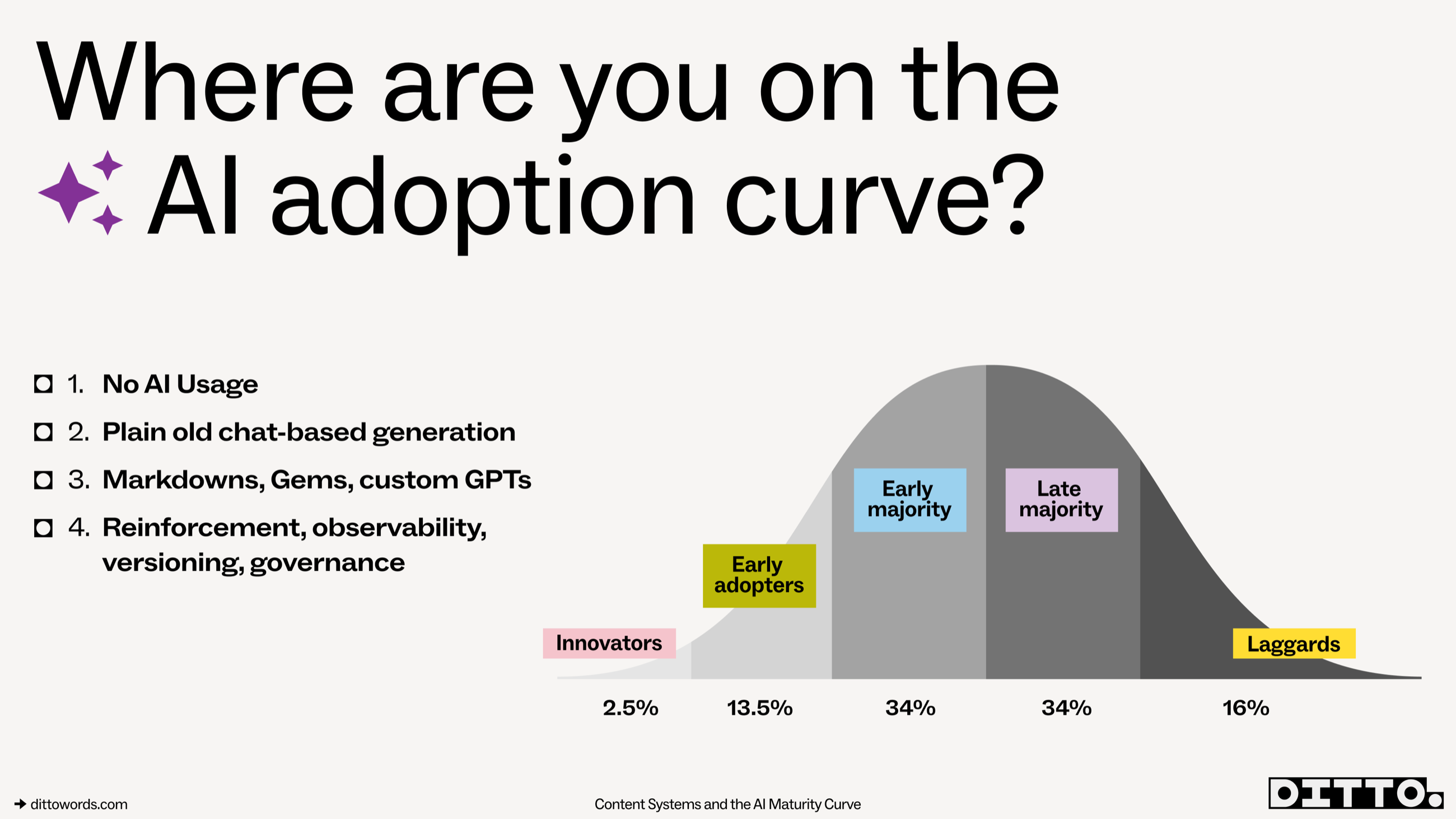
In the webinar, I laid out four phases most teams move through:
No AI usage
What it looks like: AI isn't part of the workflow yet
Where it breaks down: falling behind teammates who've already started
Chat-based generation
What it looks like: every request starts from scratch in a chat window, and outputs get copy-pasted into place
Where it breaks down: reinventing the wheel every time, inconsistent tone and language across the team, and everyone working in silos
Markdown files, skills, gems
What it looks like: context lives in files like agents.md, referenced directly by agents in the codebase
Where it breaks down: agents inconsistently follow the skills you've written, sometimes giving false confidence, and there's no visibility into what's actually being used
Infrastructure for product text
What it looks like: a single source of truth for all product text, audited, reused, and kept current automatically
This is the goal state: localization built in, formats added without extra work, gaps automatically surfaced
What changes when you move up the curve
Moving up the curve changes who owns product copy and how the whole team collaborates around it.
Copy stops being something one person patches after the fact and becomes something the team builds against. Content works the same way a design system works for components: a shared source everyone — writers, designers, engineers, and their AI agents — can pull from and trust.
That shift changes the trade-offs, too. Teams stop having to choose between speed and quality, because the system carries the quality bar instead of relying on someone catching problems downstream. And the work compounds: every fix, every term, every guideline gets reused instead of rewritten from scratch. The process gets better over time instead of going stale.
How to level up on the AI curve
If you're still in the early days of systemizing AI in your workflows, my advice is to start with conversations. Talk to your product and engineering counterparts about how they're already using AI, find the repetitive tasks worth automating, and get familiar with the basics.
Once a team has proven AI can help with tasks, the real test starts. Questions to ask yourself about your AI workflow:
Is it reliable enough that any teammate — not just the one who wrote the original prompt — gets the same result, whether they're briefing an agent or a new hire?
Is it scalable enough to hold up across twenty contributors and twenty product surfaces, not just the one workflow it was built for?
Is it portable enough to move with the work itself — from a Figma file, to a pull request, to a support doc — instead of living inside one person's chat history where nobody else can find it?
Is it repeatable enough that it still produces the same result six months from now, after the product has changed shape three times over?
This is essentially the problem we built Ditto to solve: give product copy one single source of truth that writers, designers, engineers, and AI agents can all pull from — so it's the system, not any one person, doing the work of keeping things reliable.
You have the raw ingredients, now it's time to build the system. Like having the boards for a house. Now you just need the blueprint.
Watch the webinar
Watch the full recording to hear me unpack the maturity curve in more depth, plus what you can do to advance your team’s AI workflows.





.png)