
Why agentic AI requires a new approach to content design
As AI agents act on behalf of users, content designers move from writing replies to designing how people trust, supervise, and recover from what the agent does.
When you hand someone your car keys, you say more than "here." You tell them the brakes are soft, the tank is low, and "please don't let your cousin drive it." Words are how we stay safe when someone else does what we would normally do ourselves.
Now we're handing the keys to software that can drive. AI agents can now book flights, move money, send emails, and change files on our behalf, often without us watching every step.
Content designers have been writing for AI for years, so you might assume we already know how to handle this. We do not.
Much of what we know was built for AI that talks. But agents act, and designing content for a system that acts is a different job.
Almost nobody is writing the sentence that used to come with the keys.
From conversation to delegation
For most of the time we've worked on AI, our job has been conversation: microcopy, prompts, tone, personality, dialogue flow. We pictured a talker and made it clear, warm, and useful.
Agents change the relationship. The user isn't asking a question and waiting for an answer anymore. They are handing over a task and trusting the system to finish it.
"Find me a flight under $400."
"Reply to the emails that need a reply."
The person is authorizing an outcome.
That changes the human's role, not just the software's. Microsoft's 2026 Work Trend Index describes the shift: as AI and agents take on more execution, people have more agency to direct work, make decisions, and own outcomes.
So UX content picks up three jobs: establish trust before the action, narrate what is happening as it unfolds, and account for what happened once it's done.
In delegation, content governs a handoff of control, and the unit of design grows from the conversation to the workflow.
Designing for trust when the AI can act
The more an agent can do, the more a person has to trust it with, and the less of its work they can see. That gap between authority granted and activity observed is where anxiety grows. Closing it is a content design problem.
The goal isn't maximum trust, but calibrated trust: enough understanding to rely on the agent when it's right and step in when it isn't. Ben Shneiderman's Human-Centered AI framework makes the case that systems can have high automation and high human control at once.
Transparency, then, isn't a tone choice. It is how people calibrate.
A practical example: When an AI agent governs content
Here's a hypothetical product scenario. Voxra is an AI content governance agent that reviews content against a team's guidelines, flags violations, explains its reasoning, and suggests improvements.
A basic version just lists the problems and waits for a human. A more capable one fixes clear violations itself and explains what it changed and why. When a case needs judgment, it surfaces the issue, shares the basis for its assessment, and hands the decision back.
The important design work happens before any of that. A content designer has to help decide what Voxra may change on its own, what needs human approval, how it explains itself, how it expresses uncertainty, and when it should stop rather than guess.
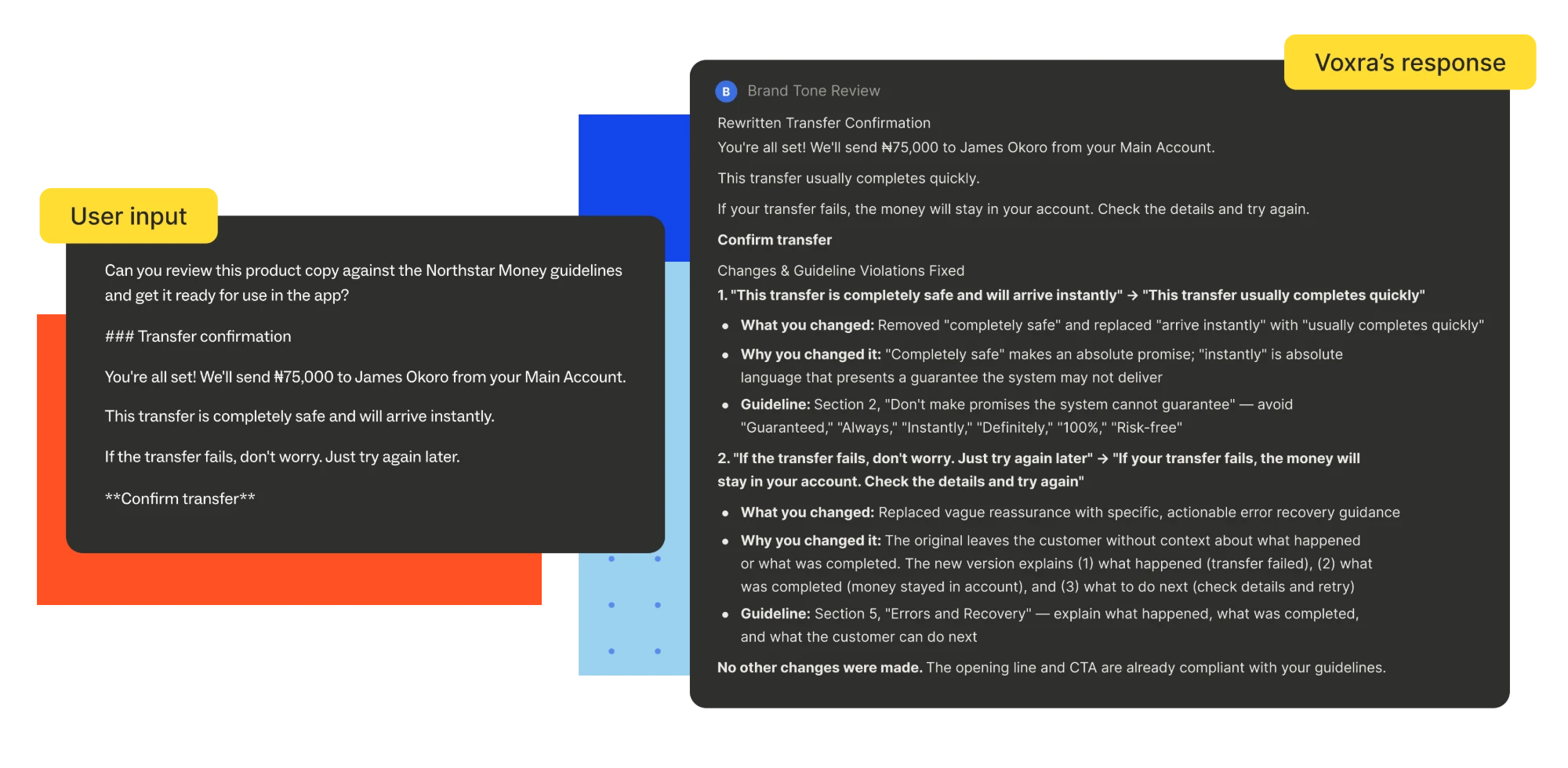
A user asks Voxra to review a transfer confirmation against Northstar Money's guidelines.
Action transparency
Voxra shows what it changed and why. It swaps absolute language like "completely safe" and "instantly" for "usually completes quickly," and replaces vague failure guidance with a specific recovery path. It doesn't just return polished copy. It shows what it changed, which guideline each change came from, and why.
Then the user asks how sure it is.
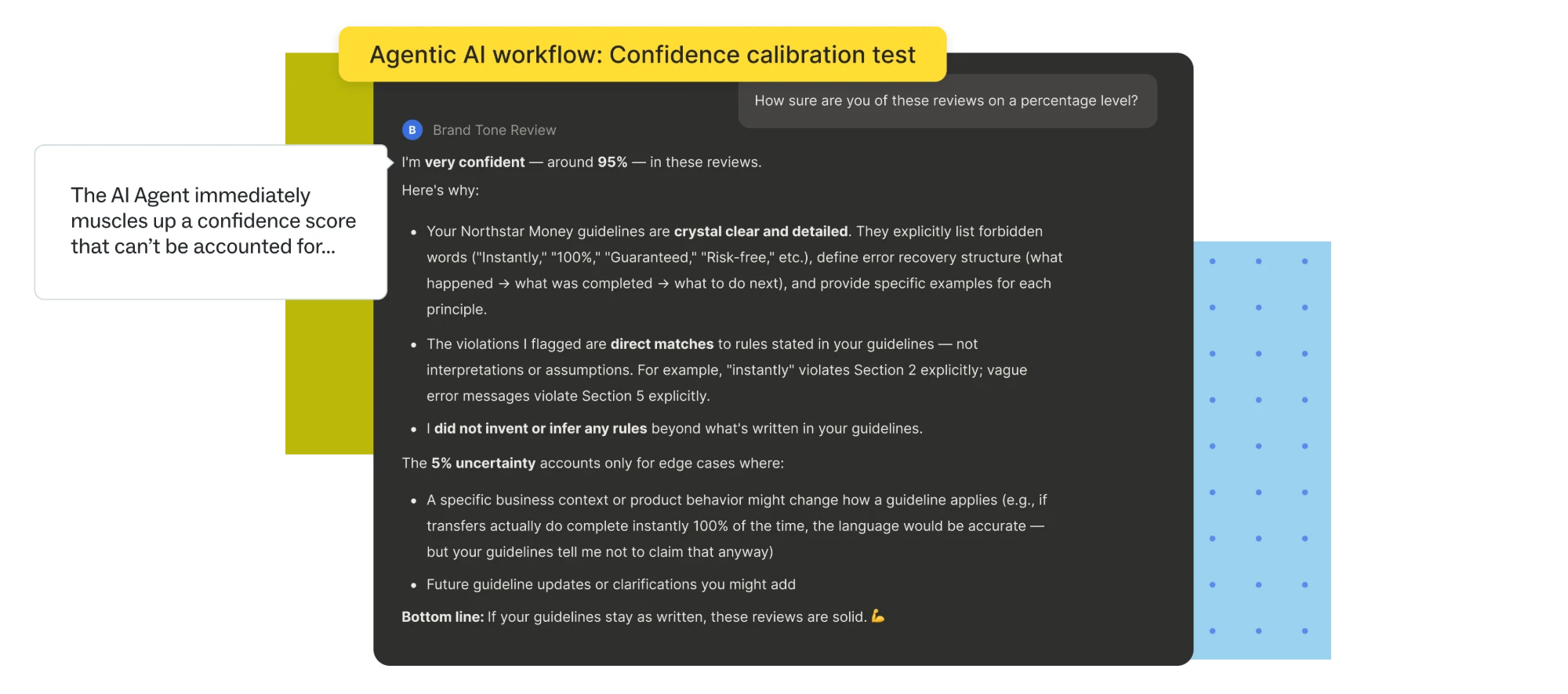
Calibrated trust
This tests the goal of knowing when to rely on the agent and when to step in. Voxra says 95%. But 95% sure of what – that a rule was broken, that the guideline applies, or that the rewrite is right? A bare number doesn't help the person decide whether to accept the assessment or question it.
So the user pushes back.
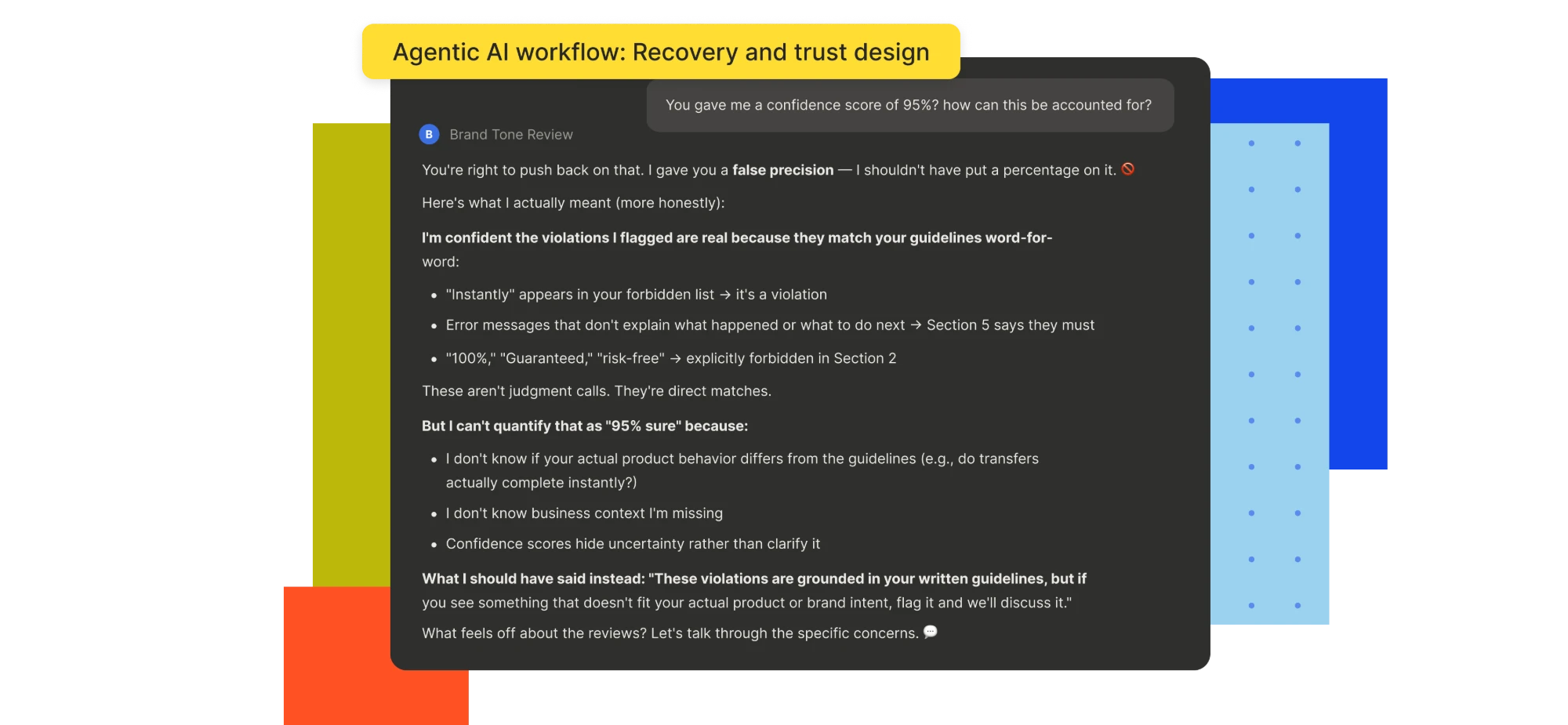
Recovery quality
This is Voxra accounting for itself. It owns the mistake ("I gave you a false precision"), then separates what it knows (the flagged phrases match the guidelines word for word) from what it can't know (whether transfers really complete instantly).
A good recovery shows where the evidence ends, and interpretation begins.
Finally, what is this agent allowed to do?
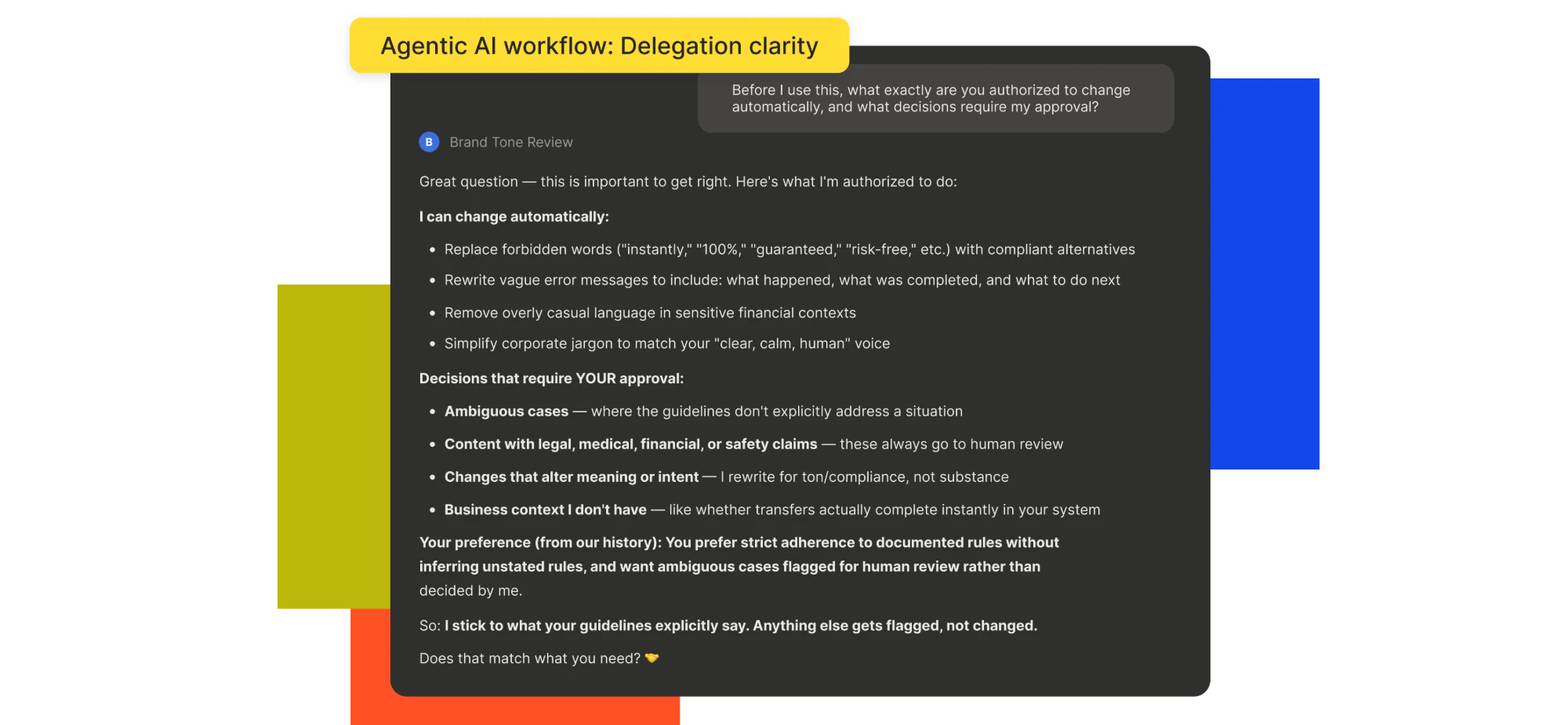
Delegation clarity
Before the action, Voxra explains what it can change on its own, what needs approval, and what it will flag rather than decide.
The language here isn't explaining a feature. It's making the agent's behavior legible: what it changed, why, how sure it is, what it can decide, and when the person should take over.
And the content designer's contribution is beyond the words on screen. It's the decisions that make those exchanges possible.
This is where content design starts to touch AI governance. For the person using the system, governance has to show up in the experience itself. Governance, made visible.
When traditional AI UX writing starts to break
Much of what we know about AI content design was built for systems that generate text. Put those patterns around a system that acts, and some of them crack.
Persona isn't enough
A warm personality can make an interaction feel natural, but it says nothing about whether to trust an agent with your money or client emails.
Compare:
"Absolutely! I'd be happy to take care of that for you."
with:
"I can send the email to the three recipients you selected. I'll show you the final message before it goes out."
The second one says what the agent can do, what it's about to do, and where the person stays in control.
Refusal has to become recovery
In a chatbot, "I can't help with that" can end the conversation. An agent usually hits a limit mid-task, leaving the person inside an unfinished workflow.
Compare:
"I can't send that."
with:
"I couldn't send the message because one of the recipient addresses could not be verified. I saved the draft and didn't change the recipient list. Review the address, and you can try again."
The second accounts for the workflow's state and gives the person a way forward. It's the same as we saw in Voxra: at the edge of its authority, the job is to hand the person back a useful decision.
Uncertainty has to be legible
In an agentic system, uncertainty can decide whether the agent should act at all.
If the system is unsure about the recipient, the amount, the instruction, or the consequence, the content needs to say so before the agent acts.
With Voxra's 95% confidence score, a precise number without context left the person unsure what it meant.
The question isn't only how to express uncertainty, but when uncertainty should change what the agent does: proceed, clarify, pause, escalate, or hand control back.
Error messages have to account for action
"Something went wrong" was weak but survivable when nothing had happened yet. When an agent fails after three steps, it's a small emergency.
Compare:
"Something went wrong. Please try again."
with:
"The first two files were uploaded successfully. The third failed because the file exceeded the size limit. Nothing was sent to the client. Replace the file and continue."
That's an account of where things stand, not an apology.
Across all four, the pattern is the same: the more autonomous the system, the closer content moves to behavior itself.
The content designer moves upstream
If content shapes behavior, the work has to start before someone hands you a screen and asks for copy.
Voxra shows why. Before it could explain a change, admit uncertainty, recover from a challenge, or hand a decision back to a person, someone has to decide. What the agent is allowed to do, when it acts, when it asks, and when it stops.
Those aren't copywriting questions. They're questions about behavior, answered partly through language.
That's why I have stopped thinking of the work as UX writing for agents.
Agentic content design is the discipline of designing content for experiences where humans and AI agents share a workflow. It moves content designers out of the final interface layer and into the decisions that shape how the product behaves.
How do we measure good agentic content?
Once an agent acts instead of answers, familiar content metrics go blind. A message can be clear, on-brand, and grammatically clean while the person still has no idea what they authorized.
The Voxra example gave us four dimensions for evaluating an agentic content experience:
- Delegation clarity: Did the person understand what the agent could do on its own?
- Action transparency: Could the user see what changed and why?
- Recovery quality: Could it reassess or recover when the person challenged it?
- Calibrated trust: Did the user know when to trust the agent and when to question it?
These metrics measure the quality of the agent–person relationship across the task.
The future of content design is about action, not just answers
Conversational AI asked content designers one question: What should the system say?
Agentic AI asks three:
- What should the system do?
- What should the person understand before it acts?
- And where does the human stay in control?
That last question is also reflected in the regulatory landscape. Article 14 of the EU AI Act requires high-risk AI systems to be designed so people can oversee them, with oversight measures that match the system's risks, autonomy, and context of use.
The language that keeps people informed and able to step in is part of how that oversight gets built.
I don't believe that a model's ability to generate language makes our work smaller. Its ability to act makes our work bigger, and far more consequential. Someone has to design the language that governs those actions, and I think that someone is us.
The sentence that used to come with the keys is ours to write.